
Search Results
158 results found with an empty search
- Does the Universe Repeat Itself? Will Dead People be Reborn in the Future?
The Big Bang is thought to have occurred 13.8 billion years ago. The Universe since then expands and our current models show that the rate of expansion is currently increasing exponentially. Of course we don't have a theory of everything, which is essential in order to answer this question beyond any doubt. However, we can understand enough about fundamental laws of physics to be able to speculate. For example, time inside black holes and at the moment of the Big Bang should continue to flow there because if there was no time flow during the Big Bang, the Universe wouldn't start to expand. Of course the idea of time is intimately related with the future and the past of the Universe. However it is not only time, it is also the second law of thermodynamics that it is well known that creates an arrow of time. Ludwig Boltzmann, the theoretical physicist that is well known for his law of increasing entropy stated: " Since a given system can never of its own accord go over into another equally probable state but into a more probable one, it is likewise impossible to construct a system of bodies that after traversing various states returns periodically to its original state, that is a perpetual motion machine. " Ludwig Boltzmann's statement is in reference to the Second Law of Thermodynamics, which states that the entropy of a closed system tends to increase over time, leading to an increase in disorder and a decrease in the amount of available energy. In essence, this law implies that systems tend to move towards more probable states, which are characterized by higher entropy. Boltzmann's statement reflects the idea that it is impossible to construct a perpetual motion machine, which is a device that can operate indefinitely without an external energy source. This is because, according to the Second Law of Thermodynamics, a perpetual motion machine would violate the law of entropy and create energy out of nothing. Boltzmann's work in statistical mechanics helped to establish the connection between the microscopic behavior of particles and the macroscopic properties of systems. His ideas laid the foundation for the development of statistical thermodynamics, which is a branch of physics that describes the behavior of systems composed of a large number of particles. The Cyclic Universe However, some scientists and philosophers have suggested that the Universe could be an exception to the Second Law of Thermodynamics. Some physicists and cosmologists have proposed the concept of a cyclic universe, which posits that the universe goes through an infinite cycle of expansion and contraction. According to this theory, the universe would repeat itself over and over again. One argument is that the Universe is not a closed system and is constantly exchanging matter and energy with its surroundings, so the law of entropy may not apply in the same way as it does for closed systems. Another argument is that the Universe is in a state of thermal equilibrium, which means that there is no temperature difference between different parts of the Universe. In such a state, there would be no energy gradient to drive the increase in entropy, and the Second Law would not apply in the same way. The second law of thermodynamics like the vast majority of laws of physics is subject to review, and may not apply at the most extreme places in the Universe. In the future when new exotic physics will be discovered a very limited number of the current laws of physics will remain valid. For example, we would expect the law of conservation of energy to remain valid, despite the new laws of physics that will be discovered in the future. Of course entropy seems to increase over time, but the definitions of time that we are familiar with might not apply to the largest possible cosmic scale. The idea of infinite time seems unreasonable like the idea of any other infinite physical quantity. The solution to the problem of infinite time is to assume that the Universe has no way to track infinite time, and that the total time in the Universe has to be zero, according to the law of conservation of time. This law has never been proposed before, but keep reading this article to learn more about it. Cosmology is the study of the Big Bang, and the evolution of the Universe. It is an exciting field of research. It has been revolutionised by theoretical models, as well as from the data of space telescopes like the HST. Although today we might think that our Universe will keep expanding forever, this leads to a singularity: infinite space and time. There should therefore exist a maximum volume of expansion. Once this volume is reached the Universe will have no choice but to start contracting until it reaches the Big Crunch. A new Big Bang will follow and a new cycle will start. Time like space can't be infinite. However, this is true according to our everyday life definitions of time only. To be more precise the total time in the Universe has to be zero . That's true, the Universe probably has no clock that can track infinity. Of course we are familiar with positive time because it is the Universe which we are living in. However, in the cosmic sense, we can regard the time of our mirror Universe arising from the contraction of space as negative. After our Universe reaches a maximum volume of expansion, space will start to contract and the clock of Universe which is based on the expansion of space rather than the movement of matter inside the space, will start to run backwards. Hence, the cosmic time will reset to zero when the Big Crunch occurs. Of course the story doesn't end there. The question that arises is if the new Big Bang that will follow will be identical to ours, or if there will be a way for the Universe to track time with the mutations that arise from each consecutive new Big Bang? In this article we have hopefully already shed light deep into the unknown, however this question that arises, requires a whole new approach to the Universe to be answered, as it delves even more deep into the unknown intrinsic properties of the Universe. Nevertheless, we can safely postulate that according to the anthropic principle it is highly likely that the new Big Bang, should give rise to a new Universe where many constants of nature can take different values. The mutations arising from each new Big Bang will therefore consist a cosmic clock. It is a wild guess, however, even this clock might reset at some time into a default mode. By exploring this ultimate cosmic clock of Big Bang mutations, with new physics that we will discover in the future we might be able to understand its complete cycle of Big Bangs. A well known way of thinking about the Universe is viewing it as an entity with total energy of zero. In this sense the Universe can be regarded as equal to nothingness at least from the point of view of matter and energy. The negative gravitational potential energy of space which is acquired upon the expansion of space balances exactly its positive energy and give us a net energy of zero. Perhaps, there is a similar point of view whereby there is negative and positive time which add up to zero. This theory would solve the philosophical problem an infinite in time Universe or even a finite one. However, although more research is required to conclusively support this theory with observations and robust mathematics, it remains our only reasonable cosmological explanation able to address a multitude of logical problems that arise from infinities. It is worth noting that the idea of a cyclic Universe is supported by many scientists, including the legendary physicist Roger Penrose. Therefore to answer conclusively the question of: "If it is possible in the future that an identical Universe will be created, with identical people living in it and doing the exact same things", while it may seem beyond our reach, it is fair to say that it is highly likely that this is the case, especially by looking at arguments of time symmetry. A universe that is not time symmetrical appears ugly to me for some reason. If you would ask me what I would prefer, I would definitely vote for a Universe that doesn't repeat itself, as this would lead to suffering not being perpetuated. However, a Universe that is limited on time appears to be as unreasonable with a Universe that is has a net amount of positive energy in it. Let alone Universes with infinite space, time and energy. So while Einstein would have thought that the Universe might be infinite, we would definitely think that the Universe is closer to zero, from the point of view of energy, space, time or even consciousness. Einstein thought that: " Only two things are infinite, the universe and human stupidity, and I'm not sure about the former. ", however even stupidity and consciousness, while they may not be physical quantities in the same way as energy or space are they almost certainly reset to zero at sometime in the Universe. However, stay tuned as this is a complicated topic worthy of separate discussion in our future magazine articles.
- Oumuamua: Why the Alleged Alien Spaceship was Accelerating Near the Earth?
In 2017, a mysterious interstellar object called Oumuamua whizzed past Earth, and scientists were perplexed by its unusual characteristics. Comets typically come from a bank of frozen objects situated at the outer solar system know as the "Oort Cloud" and accelerate when they get close to the sun because the ice inside them turns to water vapor, which is ejected outwards, acting as a thruster. This expulsion of gas results in a dust tail or a bright halo called a coma, but Oumuamua had neither of these things and was still accelerating more than it should. This led many to suggest it was an alien spacecraft being powered by an extraterrestrial engine. However, researchers from the University of California, Berkeley, and Cornell University in the US have come up with a new, more straightforward explanation. Oumuamua came from interstellar space, meaning it was bombarded with cosmic radiation. This radiation penetrated deep into its rock, reaching the ice trapped inside. This converted the water into hydrogen gas, which remained locked within it until it got near the sun. The warmth caused the comet to expel the hydrogen, which was enough to accelerate it off its trajectory. The gas would have formed a very thin shell around the comet, but would have been too small to see from telescopes on Earth.Thus, the theory that Oumuamua is an alien spacecraft has been debunked, and the researchers have concluded that it was an interstellar comet. One interesting fact about Oumuamua is its unusual shape. Observations suggest that it is highly elongated and has a cigar-like shape with an estimated length of 1km, and the object has a reddish appearance, which is quite different from any natural object in our solar system. In fact, its shape has led some researchers to suggest that it may be an artificial object or probe sent by an extraterrestrial civilization, although this idea is highly speculative and has not been supported by any evidence. Oumuamua's trajectory suggests that it came from the direction of the constellation Lyra and was traveling at a high speed relative to the Sun. It is believed to have originated from another star system outside of our own solar system, making it the first known interstellar object to have passed through our solar system. However, scientists have not been able to determine exactly where Oumuamua came from or how long it had been traveling through interstellar space before it was detected. Its origins remain a mystery, and scientists are still studying the data to learn more about this fascinating object. Oumuamua passed by the Earth at a distance of about 85 times the distance from the Earth to the Moon, or about 33 million kilometers (20.7 million miles) away. Currently, Oumuamua is no longer visible from Earth and is very far away, traveling through the depths of space. Oumuamua is currently about 34.9 astronomical units away from Earth, which is roughly 5.2 billion kilometers. It is moving away from the Sun and Earth at a speed of about 315,000 kilometers per hour. Its exact location and trajectory are constantly changing due to its motion through space and the gravitational influence of other objects in the solar system, so its current position and distance from Earth will change over time.
- A New Photo by HST Depicts NGC 5486
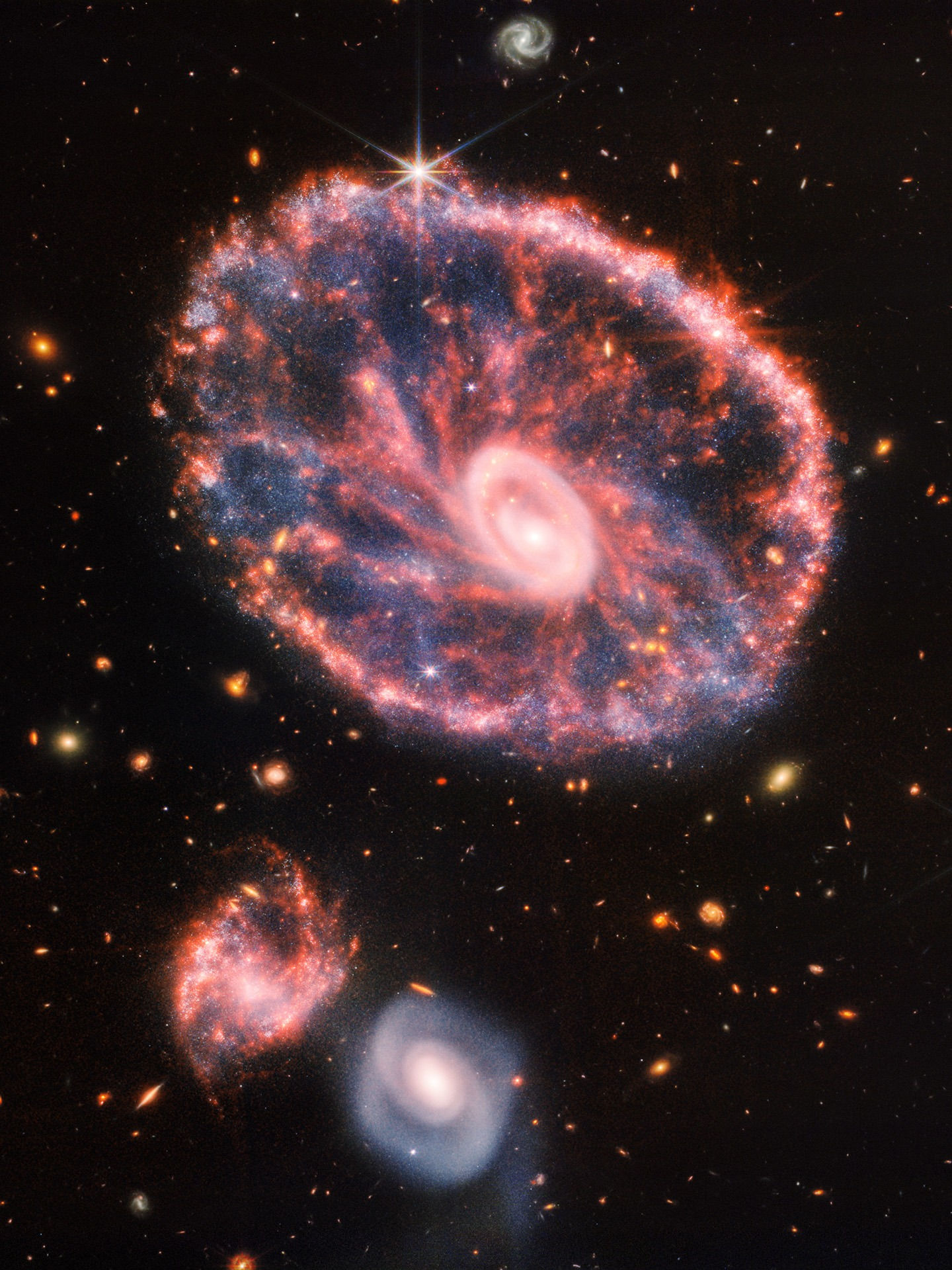
Behold! The Hubble Space Telescope has bestowed upon us a fresh image (photo above) that captures the meandering spiral arms of a faraway galaxy in the throes of star birth. Known by the name NGC 5486, this irregular spiral galaxy is perched 110 million light-years from Earth in the constellation Ursa Major. The lack of a definite shape or structure leads us to classify it as an irregular galaxy. It's highly likely that its appearance was distorted by the gravitational pull of a much larger cosmic neighbor. Brought to us by NASA on March 10, the new snapshot of NGC 5486 unveils the galaxy’s faint, wandering spiral arms and dazzling core. Moreover, the image displays several dim and remote galaxies in the backdrop. NASA spokespersons declared in a statement that “The tenuous disk of the galaxy is threaded through with pink wisps of star formation, which stand out from the diffuse glow of the galaxy’s bright core.” NGC 5486 is located in the proximity of the Pinwheel Galaxy (photo above), a grand design spiral galaxy and one of the best-known examples of the type. The Pinwheel Galaxy, also known as NGC 5457, dwells roughly 21 million light-years away from Earth in the constellation Ursa Major. It's one of the closest galaxies to our planet, twice the size of the Milky Way, and home to over a trillion stars. The space telescope took the largest and most detailed photo of a spiral galaxy ever captured back in 2006, which happened to be of the Pinwheel Galaxy. The recent image of NGC 5486 is part of an initiative to study debris left behind by Type II supernovas, which are explosive and violent stellar outbursts that occur after the sudden collapse of a massive star. "As massive stars reach the end of their lives, they cast off huge amounts of gas and dust before ending their lives in titanic supernova explosions," NASA officials stated in their recent declaration. "NGC 5486 hosted a supernova in 2004, and astronomers used the keen vision of Hubble’s Advanced Camera for Surveys to explore the aftermath in the hopes of learning more about these explosive events."
- Why the Coastal Cities of the UK will be Erased from the Map by a Massive Tsunami?
The western chunk of the Canary Island has been bubbling for years. A volcano, once mighty and fearsome, is now gradually losing its power. Some say it will break off and plunge into the ocean, causing a tsunami that will travel at the speed of 600 miles an hour. This is no secret - there is even a documentary on the Discovery Channel that details the event. The tsunami will reach the UK in 6 hours and the US East Coast in 8 hours, flooding 40 miles inland. It's a force that cannot be tamed or predicted, striking without warning. It could happen today, tomorrow, in ten years, or even 5000 years from now. The power of nature is a force to be reckoned with. The volcano may seem docile now, but it can erupt with a ferocity that will shake the very foundations of the earth. The waves will come crashing down with a vengeance, a reminder of how insignificant we are in the grand scheme of things. We cannot control nature, but we can prepare for it. We can learn from the past, studying the history of natural disasters and their impact on society. We can build better infrastructure, create evacuation plans, and educate the public on what to do in case of an emergency. The western chunk obf the Canary Island has been bubbling for years. A volcano, once mighty and fearsome, is now gradually losing its power. Some say it will break off and plunge into the ocean, causing a tsunami that will travel at the speed of 600 miles an hour. This is no secret - there is even a documentary on the Discovery Channel that details the event.when it does, we will be ready. We will face it with courage, determination, and the knowledge that we did everything in our power to prepare for it.
- Why In 30 Years from now We Will be Able to Upload Our Minds"to the Cloud"?
As the world continues to advance at an astonishing rate, one of the most exciting and potentially game-changing developments on the horizon is the idea of uploading our brains to the cloud. While this may have once sounded like science fiction, many experts now believe that it is not only possible, but likely that this will become a reality within the next decade. There are miltiple reasons that make us believe that by 2030 we will achieve digital immortality: Advancements in neuroscience and neurotechnology: With the increasing understanding of the human brain, scientists and engineers are making rapid progress in developing the necessary technology to accurately map and digitize the brain. Increasing computing power: The rapid development of supercomputers and the increasing availability of cloud computing resources make it possible to process and store the vast amounts of data required for brain uploading. Economic incentives: As the demand for increased life expectancy and cognitive enhancement grows, the market for brain uploading will become increasingly lucrative, driving research and development in the field. Government funding: Governments around the world are investing heavily in neuroscience and neurotechnology research, providing the necessary resources to accelerate the development of brain uploading technology. Collaboration between researchers and industries: With the expertise of neuroscientists, engineers, and computer scientists working together, the development of brain uploading technology is progressing at a faster pace than ever before. Breakthroughs in AI: The advancements in AI technology will allow for development of more sophisticated and accurate algorithms for simulating the human brain, making brain uploading a more viable option. There are several ways that brain uploading could potentially be achieved. One method is through the use of advanced brain-computer interfaces (BCIs), which would allow a person's brain activity to be directly translated into digital signals. Another method is through the use of advanced scanning technology, such as MRI or CT scans, which would allow a detailed map of a person's brain to be created. This map could then be used to create a digital simulation of that person's mind. In particular the technology of mapping the brain already exists, however more work is needed in combining the electrical signals into a coherent neural network and uploading it into digital form. BCIs work by measuring the electrical activity of the brain, also known as brainwaves, and translating that activity into digital signals that can be interpreted by a computer. There are several different methods for measuring brain activity, including electroencephalography (EEG), functional magnetic resonance imaging (fMRI), and magnetoencephalography (MEG). EEG is the most common method for measuring brain activity, as it is non-invasive, relatively inexpensive, and can be used to measure brain activity in real-time. EEG sensors are placed on the scalp to measure the electrical activity of the brain, which is then translated into digital signals that can be interpreted by a computer. fMRI, on the other hand, is an imaging technique that measures blood flow in the brain. It allows to measure neural activity indirectly by tracking changes in blood flow. fMRI is less portable and more expensive than EEG, but it provides a higher resolution image of the brain and can be used to measure activity in specific areas of the brain. MEG, is a neuroimaging method that measures the magnetic fields produced by electrical activity in the brain. It is also non-invasive and can provide a high temporal resolution of the brain activity. Once the brain activity has been measured, it must be translated into digital signals that can be interpreted by a computer. This is typically done using machine learning algorithms, which are able to learn to recognize patterns in the brain activity that correspond to specific actions or commands. One example of the application of BCIs is in the development of prosthetic limbs. BCIs can be used to allow people with amputations to control prosthetic limbs using their brain activity. This would enable people with amputations to perform tasks that would be difficult or impossible for them to do with traditional prosthetic limbs. Another example of the application of BCIs is in the field of communication. BCIs can be used to allow people with conditions such as ALS or locked-in syndrome to communicate using their brain activity. This would enable people with these conditions to communicate with their loved ones and healthcare providers in a more natural and intuitive way. In conclusion, Brain-computer interfaces (BCIs) are a type of technology that allows for direct communication between the human brain and a computer. The goal of BCIs is to enable people with disabilities to control devices or machines using their brain activity, and also to enable people to interact with computers in a more natural and intuitive way. They work by measuring the electrical activity of the brain, translating that activity into digital signals that can be interpreted by a computer. While BCI's are still in the research and development stage, they have shown promising results in the field of prosthetics and communication for people with disabilities. However, there are still some challenges to overcome, such as the need for more accurate and stable measurements of brain activity, and the need for more robust and user-friendly interfaces. One of the primary arguments in favor of brain uploading is that it has the potential to greatly extend human lifespan. By uploading our brains to the cloud, we could potentially live forever, or at least for much longer than current life expectancy. This would allow us to continue to learn, grow, and experience new things for an indefinite period of time. Another argument for brain uploading is that it could greatly enhance human intelligence and capabilities. With our brains in the cloud, we would have access to vast amounts of information and resources, allowing us to process and analyze information much more quickly and efficiently. Additionally, we would be able to connect and communicate with other brains in the cloud, potentially creating a collective intelligence that would far surpass anything that we can currently imagine. Despite some concerns, many experts believe that the benefits of brain uploading far outweigh the risks. As technology continues to advance at an astonishing rate, it seems increasingly likely that this will become a reality within the next decade. While there is still much work to be done, it is an exciting time to be alive, as we stand on the brink of a new era in human history.
- A New Breakthrough in the Development of Quantum Computers
A breakthrough in quantum computing has been achieved by researchers from the University of Sussex and Universal Quantum. The scientists have demonstrated that quantum bits (qubits) can transfer directly between quantum computer microchips, using electric field links to enable qubits to move from one microchip module to another with unprecedented speed and precision. This technique, dubbed ‘UQ Connect,’ allows chips to connect together like a jigsaw puzzle to create a more powerful quantum computer. Quantum computers are currently limited to 100 qubits, and millions of qubits are required to solve complex problems that are out of reach for today's most powerful supercomputers. This breakthrough technology could unlock the potential to scale up quantum computers by connecting hundreds or even thousands of quantum computing microchips, making them powerful enough to tackle important societal challenges ranging from drug discovery to solving problems in aeronautics and finance. The team was successful in transporting the qubits with a 99.999993% success rate and a connection rate of 2424/s, both of which are world records and orders of magnitude better than previous solutions. While linking the modules at world-record speed, the scientists also verified that the 'strange' quantum nature of the qubit remains untouched during transport, for example, that the qubit can be both 0 and 1 at the same time. Dr Sebastian Weidt, CEO and Co-founder of Universal Quantum, and Senior Lecturer in Quantum Technologies at the University of Sussex, said that their focus is on providing people with a tool that will enable them to revolutionize their field of work. The researchers have done something truly incredible that will help make their vision a reality. These exciting results show the remarkable potential of Universal Quantum's quantum computers to become powerful enough to unlock the many life-changing applications of quantum computing. Universal Quantum has been awarded €67 million from the German Aerospace Center (DLR) to build two quantum computers, where they will deploy this technology as part of the contract. The University of Sussex spin-out was also recently named one of the 2022 Institute of Physics award winners in the Business Start-up category. The company is working hard to deploy this technology in their upcoming commercial machines. In conclusion, the breakthrough in quantum computing achieved by the University of Sussex and Universal Quantum is a significant step towards a quantum computer that will be of real societal use. Quantum computers are set to have boundless applications – from improving the development of medicines, creating new materials, to maybe even unlocking solutions to the climate crisis. The University of Sussex is investing significantly in quantum computing to support their bold ambition to host the world's most powerful quantum computers and create change that has the potential to positively impact so many people across the world. With teams spanning the spectrum of quantum computing and technology research, the University of Sussex has both a breadth and a depth of expertise in this area. Click here for the original research paper.
- Why even a Distant Supernova Explosion can Vanish Life on Earth?
Supernova explosions are one of the most powerful phenomena in the universe, releasing vast amounts of energy that can outshine entire galaxies. These massive explosions occur when a star runs out of fuel and collapses under the force of its own gravity. The resulting explosion can be so intense that it can destroy everything in its path, including planets and even entire solar systems. While supernova explosions are rare events, they are not impossible, and if one were to occur close enough to Earth, it could spell disaster for our planet. So, just how close would a supernova explosion have to be to Earth to destroy it? The answer is not entirely clear, as it would depend on a variety of factors, including the size of the star that exploded and the orientation of the explosion relative to Earth. However, some estimates suggest that a supernova explosion as far away as 50 light-years (~485 trillion kilometers) could have a significant impact on our planet. At this distance, the explosion would release a burst of high-energy radiation, including X-rays and gamma rays, that could strip away the ozone layer in our atmosphere. This layer is crucial for protecting life on Earth from the harmful effects of the sun's ultraviolet radiation. Without it, the planet would be exposed to dangerous levels of radiation that could cause widespread damage to ecosystems and lead to an increase in cancer rates. In addition to the radiation burst, a supernova explosion could also produce a shockwave of high-speed particles that could cause widespread damage. The particles would collide with the Earth's atmosphere, creating a cascade of secondary particles that could ionize the air and produce powerful electrical currents. These currents could disrupt communication networks and even cause power outages, potentially plunging entire cities into darkness. While a supernova explosion close enough to Earth to cause catastrophic damage is rare, it is not impossible. Astronomers are constantly monitoring the skies for signs of potential threats, including nearby supernovae. Fortunately, the chances of such an event occurring in our lifetime are slim, as the closest known star capable of producing a supernova explosion is over 100 light-years away. In conclusion, while the idea of a supernova explosion destroying Earth may seem like something out of a science fiction movie, it is a very real possibility. However, the chances of such an event occurring in our lifetime are remote, and astronomers are constantly monitoring the skies for potential threats. In the meantime, we can continue to marvel at the incredible power of supernova explosions and appreciate the fact that we live in a universe that is both beautiful and awe-inspiring.
- AI Manages to Look Inside your Brain and Reconstruct your Mental Images.
The human brain is an incredibly complex organ, and researchers have been striving to understand how it represents the world around us. One approach has been to reconstruct visual experiences from brain activity, which can provide insights into how the brain and computer vision models are connected. In a newly published research paper, a team of scientists has proposed a new method based on a diffusion model to reconstruct images from human brain activity obtained via functional magnetic resonance imaging (fMRI). Diffusion models (DMs) are deep generative models that have achieved state-of-the-art performance in several tasks involving conditional image generation, image super resolution, image colorization, and other related tasks. Recently, researchers have introduced latent diffusion models (LDMs) that have further reduced computational costs by utilizing the latent space generated by their autoencoding component, enabling more efficient computations in the training and inference phases. The proposed method relies on a specific LDM termed Stable Diffusion, which reduces the computational cost of DMs while preserving their high generative performance. The team characterized the inner mechanisms of the LDM by studying how its different components relate to distinct brain functions. They demonstrated that their method can reconstruct high-resolution images with high fidelity in a straightforward fashion without the need for any additional training and fine-tuning of complex deep-learning models. Unlike previous studies of image reconstruction, this method only requires simple linear mappings from fMRI to latent representations within LDMs. Additionally, the team provided a quantitative interpretation of different LDM components from a neuroscientific perspective, demonstrating the emergence of semantic information expressed by the conditional text while maintaining the appearance of the original image. This study proposes a promising method for reconstructing images from human brain activity and provides a new framework for understanding DMs. It offers a novel approach to investigating the inner workings of the human brain and its connection to computer vision models. Click here to download the newly published research paper.
- The Ultimate Guide to Time in Physics - Why Time Isn't Infinite but Neither Finite?
Time is a fundamental concept that has been used by humans for millennia. From the earliest civilizations to modern times, measuring time has been a crucial tool for organizing human activities and improving our understanding of the natural world. One of the earliest methods for measuring time was the use of sundials. Sundials were used in ancient Egypt as early as 1500 BCE, and they were widely used throughout the ancient world. These devices used the position of the sun in the sky to indicate the time of day, allowing people to divide their day into discrete intervals. As human societies became more complex, the need for more precise timekeeping became more pressing. In the Middle Ages, mechanical clocks were invented, which used a system of gears and weights to measure time with greater accuracy than previous methods. This allowed people to schedule their activities with greater precision, and also enabled the development of new technologies, such as the steam engine, which required precise timing to function. Today, time is measured using a variety of methods, including atomic clocks, which use the vibration of atoms to measure time with incredible accuracy. Time is used in countless ways in modern society, from scheduling appointments to coordinating international trade and transportation. Time is an important component for every parameter of life on Earth. The benefits of measuring time are many. By knowing the time of day or year, we can plan our activities more effectively and make the most of our limited resources. Measuring time has also enabled us to understand the natural world in new ways, such as tracking the movement of the stars and planets, and studying the cycles of the seasons. Additionally, measuring time has allowed us to develop new technologies and systems that have transformed human society. From the development of the steam engine to the invention of the internet, accurate timekeeping has been a key factor in the progress of human civilization. In conclusion, time has been a crucial concept throughout human history, and the benefits of measuring time are clear. By understanding the passage of time and developing methods for measuring it accurately, we have been able to achieve remarkable advancements in science, technology, and human society as a whole. There are many possible ways to measure time, but all of them involve a relative comparison of the duration of an event to the most basic unit of time. For example, we can measure time with respect to the periodic motion of the Earth around the sun, or the vibrations of atoms in a crystal. Without these reference points, there would be no way to determine the duration of an event or to compare it to other events. This highlights the fact that our understanding of time is intimately tied to our understanding of the physical universe and its underlying laws. The idea that time is a fundamental aspect of the universe, rather than a human invention, is a consequence of the fact that movement and change are also fundamental aspects of the universe, and that time provides a way to measure and describe these changes. If you are interested to learn more about time in the context of mathematical astronomy you are strongly advised to read this article . Time and modern physics Artistic illustration of a black hole. Black holes are objects with extremely strong gravitational fields and cause a significant time dilation. We can think of gravitational time dilation as restricted movement due to strong gravity. What Einstein taught us is that there is no absolute time. Experiments have proven him correct. There are only two ways that we can play with time, but it would be unfair to call this game a real time travel. The first is what Einstein called "Special Theory of Relativity or SR", and the second is the "General Theory of Relativity or GR". According to the SR, time is relative with respect to the velocity of an object, and according to the GR, time is relative with respect to position and gravity. If we therefore change our position, time will become relative. Time is also relative for different strengths of gravity. For a photon time appears to freeze. The same is true for an object on the event horizon of a black hole. Artistic illustration of photons. Photons are packets of energy without a rest mass, but can be regarded like waves with a specific frequency f, which is related to the energy of the photon with the equation E=hf. Of course according to special relativity, the speed of light is the speed limit, and the speed of light is measured to be the same from all moving frames of reference. This equivalence principle, has as a direct consequence the Lorentz transformations, which predict the relativistic time dilation for moving objects. This means that time should move slower for objects that approach the speed of light. Time and the Big Bang The Big Bang is thought to have occurred 13.8 billion years ago. The Universe since then expands and our current models show that the rate of expansion is currently increasing exponentially. Of course we don't have a theory of everything, which is essential in order to understand time inside black holes and at the moment of the Big Bang. However, time should continue to flow there because if there was no time flow during the Big Bang, the Universe wouldn't start to expand. Singularities are thought to exist at the center of black holes where we reach infinite drnditirs and time stops. However, this is just a sign that our current theories collapse there, rather than the existence of true infinities. Mathematics should be interpreted with caution when apply them to the physical world. Next, there exists the philosophical problem of infinite time, or how it is possible for time to be finite. In this article, we will show a way out of this philosophical problem. In physics infinities signify theory collapse. A Universe, with infinite mass, energy, temperatures, densities, space, time or any other physical quantity is something incomprehensible. A Universe with infinite expandable size should probably have infinite densities during the Big Bang, since space should itself have a material reality in order to expand. In addition, the idea of a wave is extremely common in modern physics, from the idea of a particle or a photon being a wave to gravitational and electromagnetic waves. A wave requires a material medium in order to propagate, and "empty space" is the only medium where such waves could propagate. The Cyclic Universe Cosmology is the study of the Big Bang, and the evolution of the Universe. It is an exciting field of research. It has been revolutionised by theoretical models, as well as from the data of space telescopes like the HST. Although today we might think that our Universe will keep expanding forever, this leads to a singularity: infinite space and time. There should therefore exist a maximum volume of expansion. Once this volume is reached the Universe will have no choice but to start contracting until it reaches the Big Crunch. A new Big Bang will follow and a new cycle will start. Time like space can't be infinite. However, this is true according to our everyday life definitions of time only. To be more precise the total time in the Universe has to be zero . That's true, the Universe probably has no clock that can track infinity. Of course we are familiar with positive time because it is the Universe which we are living in. However, in the cosmic sense, we can regard the time of our mirror Universe arising from the contraction of space as negative. After our Universe reaches a maximum volume of expansion, space will start to contract and the clock of Universe which is based on the expansion of space rather than the movement of matter inside the space, will start to run backwards. Hence, the cosmic time will reset to zero when the Big Crunch occurs. Of course the story doesn't end there. The question that arises is if the new Big Bang that will follow will be identical to ours, or if there will be a way for the Universe to track time with the mutations that arise from each consecutive new Big Bang? In this article we have hopefully already shed light deep into the unknown, however this question that arises, requires a whole new approach to the Universe to be answered, as it delves even more deep into the unkown intrinsic properties of the Universe. Nevertheless, we can safely postulate that according to the anthropic principle it is highly likely that the new Big Bang, should give rise to a new Universe where many constants of nature can take different values. The mutations arising from each new Big Bang will therefore consist a cosmic clock. It is a wild guess, however, even this clock might reset at some time into a default mode. By exploring this ultimate cosmic clock of Big Bang mutations, with new physics that we will discover in the future we might be able to understand its complete cycle of Big Bangs. A well known way of thinking about the Universe is viewing it as an entity with total energy of zero. In this sense the Universe can be regarded as equal to nothingness at least from the point of view of matter and energy. The negative gravitational potential energy of space which is acquired upon the expansion of space balances exactly its positive energy and give us a net energy of zero. Perhaps, there is a similar point of view whereby there is negative and positive time which add up to zero. This theory would solve the philosophical problem an infinite in time Universe or even a finite one. However, although more research is required to conclusively support this theory with observations and robust mathematics, it remains our only reasonable cosmological explanation able to address a multitude of logical problems that arise from infinities. It is worth noting that the idea of a cyclic Universe is supported by many scientists, including the legendary physicist Roger Penrose.
- Why Time Can't Stop: There is one Force in Nature Stronger than the Gravity of a Black Hole
Time is a fundamental concept that has been used by humans for millennia. From the earliest civilizations to modern times, measuring time has been a crucial tool for organizing human activities and improving our understanding of the natural world. Time dilation is a fascinating phenomenon that occurs when an object is moving at a high velocity relative to an observer. According to the theory of relativity, time appears to move slower for the moving object than for the observer who is at rest. What one observer perceives as happening in a certain amount of time, another observer moving at a different velocity may perceive as happening in a different amount of time. One way to think about time dilation is through the concept of the "light clock." Imagine a clock consisting of a beam of light bouncing back and forth between two mirrors. If we observe this clock while it is stationary, we would see the light beam moving up and down at a fixed rate, which we would interpret as the passage of time. However, if we observe this clock while it is moving at a high velocity relative to us, the light beam will appear to travel a longer distance and take a longer time to complete a cycle. As a result, time appears to move slower for the moving clock relative to the stationary clock. The constancy of the speed of light is a crucial aspect of special relativity and the concept of time dilation. The speed of light is considered to be the same for all observers, regardless of their motion relative to the source of the light. This means that the light clock analogy works specifically because the speed of light is constant, and the distance that the light beam travels appears longer to a moving observer due to the relative motion between the observer and the clock. If we were to use a ball instead of a beam of light in the clock, we would not observe time dilation at small speeds, since the speed of the ball would not be the same for all observers. Time dilation only occurs when an object is moving at a significant fraction of the speed of light, where the effects of relativistic motion become noticeable. The constancy of the speed of light is one of the fundamental postulates of special relativity, which is based on experimental evidence and has been verified through numerous experiments. The postulate states that the speed of light in a vacuum is always the same, regardless of the motion of the observer or the source of the light. One possible explanation for this constancy is that it arises from the structure of spacetime itself. According to special relativity, spacetime is not a fixed, static arena, but rather a dynamic, malleable entity that is affected by the presence of matter and energy. The properties of light and its interaction with spacetime are therefore intimately linked. In fact, the constancy of the speed of light is a consequence of a more general principle known as the principle of relativity, which states that the laws of physics are the same for all observers in uniform motion relative to each other. This principle, combined with the postulate of the constancy of the speed of light, forms the basis of special relativity. While the ultimate reason for the constancy of the speed of light may still be a mystery, it is a well-established principle that has been confirmed by a vast body of experimental evidence and is an essential component of modern physics. The idea of a dynamic, non-static spacetime is in accordance with modern observations of the expansion of the universe. According to the Big Bang model, the universe began as an infinitely hot and dense point, and has been expanding and cooling ever since. The expansion of the universe is described by the metric of spacetime itself, which is a dynamic entity that can change over time. One consequence of this dynamic spacetime is that the light emitted by distant galaxies can be redshifted due to the expansion of space. As the universe expands, the wavelength of light from distant sources is stretched, causing it to appear redder than it would if the universe were not expanding. This effect, known as cosmological redshift, is one of the key pieces of evidence for the expanding universe and the Big Bang model. In addition, the structure of spacetime itself can be affected by the distribution of matter and energy in the universe. The presence of massive objects such as galaxies and black holes can cause distortions in spacetime known as gravitational lensing, which can bend and magnify the light from distant sources. Overall, the idea of a dynamic, non-static spacetime is an essential component of modern cosmology and is supported by a wealth of observational evidence. Time dilation may seem like a bizarre concept, but it has been proven through numerous experiments, such as the famous Hafele-Keating experiment in 1971. In this experiment, atomic clocks were flown around the world on airplanes, and the results showed that the clocks on the planes ran slower than clocks on the ground. The implications of time dilation are significant and have practical applications in our daily lives. For example, GPS satellites, which are in orbit around the Earth, must take into account time dilation in order to provide accurate location information. In addition to its practical applications, time dilation has also captured the imagination of science fiction writers and has been featured in many popular works, such as the movie "Interstellar." The concept of time dilation is indeed a fascinating and mind-bending topic that offers a glimpse into the strange and wonderful world of physics. While the concepts of time dilation and relativity are indeed well-established in physics, they can still be mysterious and difficult to grasp intuitively for many people. The counterintuitive nature of time dilation, where time appears to move slower for an object in motion relative to an observer, can challenge our everyday understanding of time and space. Furthermore, while the underlying principles behind time dilation are well understood, there are still ongoing research efforts to explore its applications and implications in various areas of physics. For example, researchers are currently exploring the effects of time dilation on quantum systems, which could have implications for the development of quantum technologies. Gravitational time dilation: Time is also relative to the gravitational field strength. This has also been proven experimentally, and is supported theoretically by the general theory of relativity. We can think of the gravitational time dilation as the restricted movement of clocks due to the presence of gravitational fields. What is more, as an object falls towards a black hole, it will experience increasingly strong tidal forces as it approaches the singularity. These tidal forces arise from the fact that the gravitational field near a black hole is extremely strong and is not uniform, meaning that different parts of an object will experience different gravitational forces. This can cause the object to be stretched or compressed, and can even cause it to be torn apart if the tidal forces are strong enough. So if we try to visualize a clock near enough the center of a black hole, then the truth is that this clock can't actually exist because it is being destroyed by tidal forces. Every particle in nature constitutes a clock according to the equations: E=hf and E=mc^2. This means that m= hf/c^2, or in other words that a specific frequency corresponds to every particle of nature. However, even when the matter has been decomposed to the greatest extend into the most elementary particles, this equation would also break down as the wavelength would be red shifted. The ultimate fate of matter falling into a black hole is still an area of active research and debate among physicists. It is possible that matter falling into a black hole will be broken down into its constituent particles, and that these particles will eventually be destroyed as they approach the singularity. At this point, the concept of time as we know it, may lose its meaning, and the laws of physics as we currently understand them may break down. It is also possible that there is a more complete theory of quantum gravity that could describe the behavior of matter near a black hole singularity, and that this theory could shed new light on the ultimate fate of matter falling into a black hole. Ultimately, the behavior of matter and energy near a black hole singularity remains one of the great mysteries of modern physics, and is an active area of research for theoretical physicists. Time as we know it should perhaps stop at the center of a black hole. There is nevertheless a force in nature that is even stronger than the gravity of a black hole, that can make the clock of any black hole in nature to start ticking again. This force is the cosmic expansion of space after the Big Bang. Therefore, the time that depends on this clock still exists and what is more during the Big Bang the Universe was perhaps a black hole, and this ultimate force of cosmic expansion was able to get the Universe out of the black hole state. Thanks to this force we don't live in a singularity and we are on earth to ask questions about the secrets of the Universe.
- Which are the Toughest Animals on the Planet, and why they Would Survive a Nuclear Disaster?
Did you know about the Tardigrade, also known as the "water bear"? It's a tiny, water-dwelling animal that can survive extreme conditions that would kill almost any other known life form. Tardigrades can withstand pressures six times greater than those found in the deepest ocean trenches, temperatures close to absolute zero, and doses of radiation hundreds of times higher than the lethal dose for a human. They can also go without food or water for more than a decade and still come back to life when rehydrated. Scientists believe that their incredible toughness is due to a variety of adaptations, including the ability to produce special protective sugars and to enter a state of suspended animation in response to stress. Tardigrades are microscopic animals, typically measuring only 0.5 millimeters in length. They have a simple anatomy, with a body composed of a head, four segments, and eight legs. Their lifespan can vary greatly depending on the species and the conditions they are subjected to, but some species have been known to live for several years in the right environment. In terms of size, tardigrades are among the smallest multicellular animals known to science, but they are also incredibly tough and capable of withstanding a wide range of environmental conditions that would be lethal to most other life forms. They are truly amazing creatures that continue to amaze and inspire scientists to this day. One of the main areas of interest for scientists is the mechanism by which tardigrades are able to withstand extreme dehydration and still come back to life. This has led to the discovery of a number of unique biological processes and adaptations that help tardigrades survive in adverse conditions. For example, tardigrades are able to produce special protective sugars called trehalose that help to preserve cellular structures and prevent damage during dehydration. Additionally, tardigrades are able to enter a state of suspended animation, known as cryptobiosis, in which metabolic activity is greatly reduced, allowing them to survive extreme conditions. Another area of research is the use of tardigrades as a model for studying the effects of radiation on living organisms. Tardigrades are highly resistant to ionizing radiation and can survive doses that would be lethal to most other life forms. This has led to a greater understanding of the mechanisms by which radiation damages cells and has implications for developing protective strategies for humans in high-radiation environments, such as astronauts in space. These are just a few examples of how tardigrades have been used to gain insight into the biology of longevity and survival. As researchers continue to study these fascinating animals, it is likely that we will uncover even more secrets about the limits of life and the resilience of living organisms. Scientists believe that tardigrades are able to protect themselves against the damaging effects of radiation in a number of ways. One mechanism is through the production of protective proteins that repair damage to DNA caused by radiation exposure. These proteins are able to detect and repair any breaks in the DNA molecule, preventing the formation of mutations that can lead to cell death. Another way that tardigrades protect themselves against radiation is by entering a state of cryptobiosis, in which metabolic activity is greatly reduced. During this state, the tardigrade becomes highly desiccated, or dried out, and its metabolic rate slows down dramatically. This helps to reduce the level of damage to the tardigrade's cells caused by radiation exposure, since fewer metabolic processes are taking place that could be disrupted by the radiation. In addition, tardigrades are able to produce a variety of other protective compounds that help to defend against radiation damage. For example, they produce antioxidants that can scavenge harmful free radicals produced by ionizing radiation, and they are also able to produce a special sugar called trehalose that helps to preserve cellular structures and prevent damage to the tardigrade's cells. Taken together, these mechanisms allow tardigrades to withstand extremely high levels of ionizing radiation, making them one of the most radiation-resistant forms of life known to science.
- The Volcano Wakes Up: An Imminent Catastrophe of the World. Earthquakes are just the Beginning?
The earth trembles and the ground shakes. The sky darkens with ash and smoke as the fiery rage of a volcano erupts from deep beneath the sea. The beast is known as Columbo, an underwater monster that could destroy Europe and the Middle East, and its wrath is brewing beneath the tranquil waters of the Mediterranean Sea. Located just 7 kilometers from the Greek island of Santorini, Columbo is a ticking time bomb. As the magma boils and bubbles beneath the surface, scientists from Imperial College London and the University of Oregon warn that the reservoir of magma is growing rapidly. They cannot predict the exact date when the eruption will occur, but they know it is coming. When Columbo erupts, it will send a column of ash and volcanic gases tens of kilometers into the sky. This will form a dust cloud that will spread across the planet, blocking out the sun's rays and plunging the world into a volcanic winter. The consequences will be catastrophic, affecting the rest of the world in ways we cannot imagine. The ash cloud will disrupt air travel, leaving millions of people stranded. The dust will settle on crops, destroying harvests and causing food shortages. The lack of sunlight will cause temperatures to drop, leading to a global cooling that will devastate ecosystems and threaten biodiversity. The resulting chaos and economic collapse could plunge the world into an era of darkness that could last for years. It's easy to dismiss the threat of Columbo as a mere possibility, but the reality is that we are living on a planet that is constantly changing and evolving. We cannot predict with certainty what the future holds, but we can prepare ourselves by being aware of the risks and taking action to mitigate them. The 1650 eruption of Kolumbo volcano remains one of the most destructive and deadly events in the annals of natural disasters. As the tempestuous giant stirred beneath the Mediterranean waters, its fury unleashed an explosive onslaught of pumice and ash, blanketing even the far reaches of Turkey with its wrath. The pyroclastic flows that ensued were nothing short of cataclysmic, resulting in the loss of countless lives and untold devastation. Nearly 70 souls were snuffed out on Santorini, as the rampaging magma forged a temporary island in its wake - henceforth christened Kolumbo, meaning "swimming" in the native tongue. As the fire-breathing leviathan continued to spew forth its molten vitriol, a monstrous tsunami emerged from its depths, likely born of the cone's catastrophic collapse. Its crushing waves wrought havoc upon the neighboring islands, reaching as far as 150 km in their destructive wake. But the worst was yet to come. As the noxious fumes of H2S - a lethal poison - wafted through the air, the hapless livestock of the region fell one by one, their lives snuffed out by the toxic haze. The legacy of Kolumbo's 1650 eruption is etched into the very fabric of Santorini and the surrounding lands, a stark reminder of the raw power that nature holds over us all. The eruption of Columbo is not a matter of if, but when. We must heed the warnings of the scientists and prepare ourselves for the worst-case scenario. The fate of our planet and the survival of our species depend on it. The time to act is now. Scientists are very concerned because of the magma that was recently accumulated. An increase in the volume of magma dramatically increases the chances of a deadly eruption, and for that reason scientists constantly monitor the volcano so that they can evacuate the area a few days in advance before the imminent eruption.


