
Space Weather and the Fragile Earth
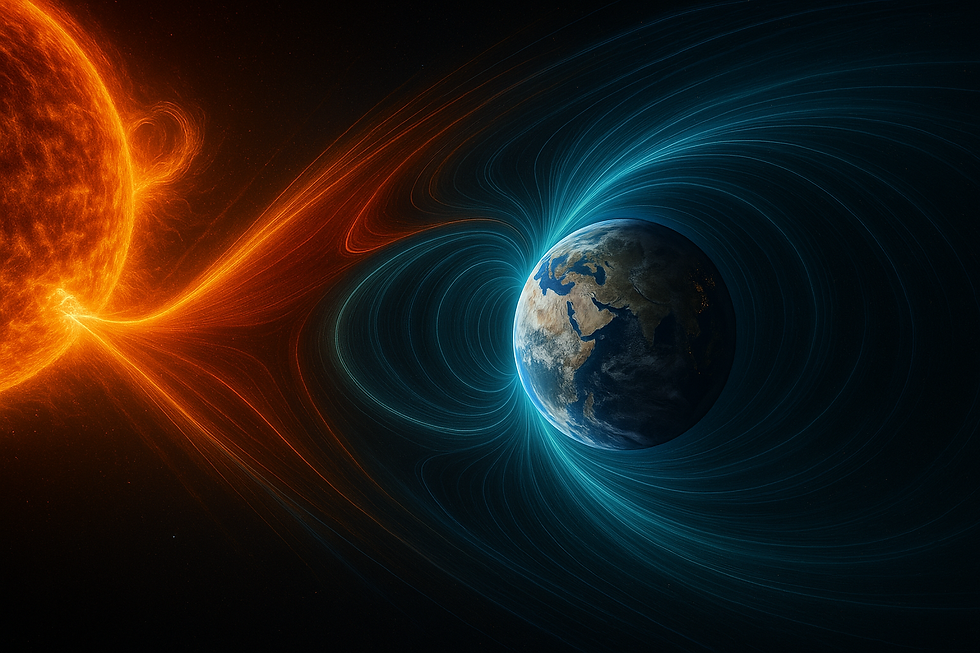
Space weather is the ebb and flow of solar activity—flares, coronal mass ejections, and high‑energy particles—washing over Earth’s magnetic cocoon.
Most days it paints auroras and leaves our technology alone.
Some days it surges, disrupting satellites, power grids, and radio links in minutes.
Understanding this Sun–Earth connection is no longer niche heliophysics; it’s critical infrastructure science.
This article surveys how the Sun drives disturbances, how radiation affects astronauts and electronics, how engineers harden systems, and how forecasting tools give us a head start.
Solar Dynamics and Flares

The Sun’s churning magnetic fields store energy that can explode as solar flares—bursts of electromagnetic radiation across the spectrum—and as coronal mass ejections (CMEs), billion‑ton clouds of magnetized plasma launched into space.
When a CME’s magnetic field is oriented southward, it couples strongly with Earth’s north‑pointing field, opening a door for energy to pour into the magnetosphere.
The result can be geomagnetic storms that agitate currents in the upper atmosphere and induce voltages in long conductors on the ground.
Indices like Kp and Dst quantify storm intensity, while real‑time solar wind data from spacecraft at the L1 point provide crucial lead time—tens of minutes to an hour—before conditions reach Earth.
For aviation and HF radio users, even flare‑only events can cause sudden ionospheric disturbances that black out communications over the sunlit hemisphere.
Radiation Hazards for Astronauts

Beyond Earth’s protective atmosphere and magnetic field, energetic particles—solar energetic particles (SEPs) and galactic cosmic rays (GCRs)—pose health risks.
Acute SEP events can deliver high doses over hours, while chronic GCR exposure increases long‑term cancer and neurocognitive risks.
Shielding is a trade‑off: more mass helps but penalizes launch and maneuvering.
Materials rich in hydrogen, like polyethylene or water, are effective at slowing charged particles.
Operationally, missions adopt ‘storm shelter’ concepts—densely shielded compartments around water tanks or supplies—and flexible timelines to pause EVAs when solar monitors warn of elevated particle fluxes.
Future deep‑space habitats will combine predictive models, active dosimetry, and smart routing to keep cumulative doses within limits.
Protecting Satellites and Infrastructure

Geomagnetic storms and radiation affect spacecraft in multiple ways: surface charging, single‑event upsets in electronics, atmospheric drag that alters orbits, and sensor anomalies.
Engineers respond with radiation‑tolerant components, watchdog architectures, and safe‑mode routines that gracefully shed loads and reboot. Constellation operators plan collision avoidance with extra drag in mind after major storms swell the upper atmosphere.
On the ground, long transmission lines and pipelines can pick up geomagnetically induced currents (GICs) that stress transformers and corrode metal.
Grid operators mitigate risk with real‑time monitoring, series capacitors to block quasi‑DC currents, and playbooks to reconfigure networks during severe events.
Redundant communications paths and hardened timing sources (multi‑GNSS with holdover oscillators) preserve synchronization when parts of the network falter.
Forecasting and AI Prediction Systems

Forecasting space weather is a chain: active‑region detection on the Sun, CME tracking through coronagraphs, solar wind sampling upstream of Earth, and magnetospheric response models.
New AI systems ingest multi‑modal data—magnetograms, EUV imagery, and in‑situ plasma measurements—to nowcast storm severity and regional impacts.
Hybrid physics‑informed networks can emulate computationally heavy magnetohydrodynamic models in near‑real time.
On the user side, tailored alerts matter: satellite operators care about drag and radiation belts; airlines need HF radio and polar route advisories; grid operators want GIC forecasts with feeder‑level resolution.
The goal is not perfect prediction but actionable minutes‑to‑days guidance that turns surprise into preparation.
Conclusion

Space weather will always be with us; dependence on vulnerable technology ensures its relevance.
By combining better solar monitoring, resilient engineering, and smarter forecasts, we shift from reacting to anticipating.
The aurora’s beauty and the storm’s bite are two faces of the same system—one we can learn to live with, if we respect its power.


For tech enthusiasts and forward-thinkers who value strategic planning and a dedicated community to share insights on scientific advancements, joining a network like the winadda is a fantastic way to connect with others who strive for knowledge and growth. These astrophysical insights highlight that a commitment to continuous monitoring, predictive modeling, and resilient engineering remains the ultimate tool for safeguarding modern civilization against the volatile elements of space